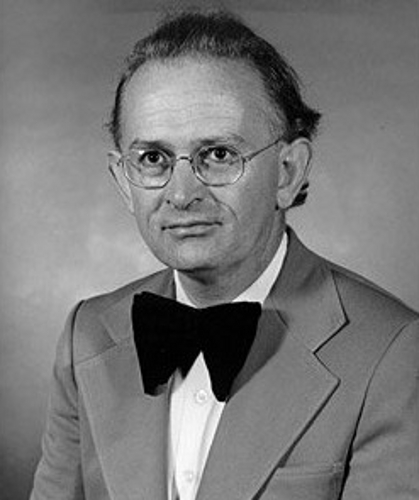
 Gart Westerhout, ca. 1980. Photo courtesy of USNO
Gart Westerhout
Contributed by William E. Howard III
Gart Westerhout was born 15 June 1927 in The Hague, The Netherlands. He was the son of Gart Westerhout, an architect, and Magda Foppe, an author. His interest in astronomy dates from when his father designed a sanitarium for tuberculosis patients who could gaze at constellations while lying on their backs. Prompted by reading several popular books about astronomy, he became a student at Leiden University in 1945. In early 1950 he started research in radio astronomy, working with Jan Hendrik Oort on a model of the Galactic continuum radiation (Westerhout and Oort 1951, BAN 11, 323), and then became heavily involved in the first 21-cm Galactic hydrogen-line studies carried out with the Kootwijk Wurzburg antenna. In 1954 he had a five-month stint of military service that was cut short when Oort convinced the State Council that Gart's work was indispensable to the Observatory. In 1955 he and Maarten Schmidt developed the first detailed 21-cm map of the Milky Way that showed the first hints of spiral structure in the interstellar gas, revealed differential rotation in our Galaxy, and established a revised Galactic coordinate system still in use today. After 1956, using the Dwingeloo 25-meter radio telescope, Westerhout worked on a major 75-cm survey (Seeger, Westerhout, Conway, Hoekema 1965: BAN 18, 11), and carried out early work on polarization of the Galactic background radiation. He used the Dwingeloo antenna to produce the "Westerhout Radio Catalog" (Westerhout 1958: BAN 14, 215) that eventually identified 79 sources that were continuum emitters including some of the largest star formation regions in the Milky Way. During these exciting times at Leiden he was among the youngest in a pioneering group of his contemporaries that included Hendrik van de Hulst, Hugo van Woerden, C. Lex Muller, Maarten Schmidt, Lodewijk Woltjer, and Charles L. Seeger, Jr. (son of the ethnomusicologist and brother of Pete Seeger). While at Leiden University, he held the posts of Assistant (1952-56), Scientific Officer (1956-59), and Chief Scientific Officer (1959-62). He was awarded Physics and Astronomy degrees from the University of Leiden: Cand. (1950) and Drs. (1954) and was awarded a Ph.D. in Astronomy and Physics in 1958. At his first IAU General Assembly, at Dublin in 1955, Gart met Judith Monaghan, who worked at the Dublin Institute for Advanced Studies; they fell in love and were married a year later.
Westerhout came to the US in 1962 as Professor and Director of Astronomy at the University of Maryland where, during the next 15 years, he grew a 12 graduate student department into one of the nation's prominent astronomy programs. In 1972, Dr. Westerhout organized the University of Maryland's division of mathematical, physical and engineering sciences and was named its head the next year. He continued his research with a 21-cm survey that used the 300-foot radio telescope of the National Radio Astronomy Observatory to extend to higher angular resolution our knowledge of Galactic structure. He often flew a rented plane between Maryland and Green Bank with his programmer, Heinz Wendtland. He continued at Maryland in that role through 1973, with additional responsibilities from 1972-73 as Chairman of the Division of Mathematical & Physical Sciences and Engineering. He was a Visiting Astronomer at the Max-Planck-Institut für Radioastronomie in Bonn, Germany in 1973-74.
In 1977 he left the University of Maryland to become the Scientific Director of the U.S. Naval Observatory in Washington DC. While there, he guided the evolution of that observatory toward astronomical data obtained from telescopes at the Flagstaff station. He initiated the radio astrometry in 1979 by using the Green Bank interferometer to improve the absolute positions of celestial objects by a factor of ten over the optical. It yielded measurements of the Earth orientation parameter UT1 that were a factor of four better than the PZTs. In the 1980s, he converted to VLBI, again increasing the precision by a factor of ten. He then looked into the use of optical long base line astrometry for absolute positions. This now achieves about an order of magnitude precision over other ground-based measurements but is not as precise as space-based measurements. In the 1980s, he introduced the use of CCDs at Flagstaff's parallax program that supplanted the use of optical plates, improving the precision by a factor of five. He was responsible for a major expansion of the organization and construction of a network of five radio telescopes from Florida to Hawaii that measured the rotation of the Earth. Westerhout retired in 1993.
Gart Westerhout was an amiable and affable man, a great and noble man, with an exceptional sense of humor and an infectious laugh. He wore a bow tie, had flamboyance seldom found among his academic colleagues, and was held in exceptional high regard by his students. In his early career he smoked cigars, a signature identification. He, Judith and the children became American citizens in 1969. They loved to entertain, and their friendships went far beyond his profession. He was an avid O-gauge model railroader and maintained a detailed layout that took up most of the basement space in his home. Westerhout's own recollections of his career are included in several hours of oral interviews conducted by Steven Dick at the end of his USNO career and they are deposited at the USNO library. He was a communicant of St. Thomas Aquinas Roman Catholic Church in Hampden.
Westerhout was a member of numerous astronomical organizations, including the Dutch Astronomical Society, International Astronomical Union (Commissions 33, 34, 40, 24 & 5), the American Astronomical Society (Councilor 1975-78 & Vice President 1985-87), the Royal Astronomical Society, the Astronomical Society of the Pacific, the USNC-URSI - Commission J, and Sigma Xi. He contributed his scientific and management expertise widely, for example to the IAU, the National Science Foundation, the AAS, the National Research Council, Associated Universities Inc., the Inter-Union Committee for the Allocation of Frequencies , URSI, the US National Radio Astronomy Observatory, MPIfR, MIT's Haystack Observatory, the Arecibo Observatory, and the National Academy of Sciences.
Westerhout's awards and special recognition included a NATO Fellowship, a CSIRO (Australia) Fellowship, an Award for the Teaching of Science, Washington Academy of Sciences, Humboldt Prize.
Westerhout was the author of more than 70 scientific papers, reviews and reports. In recognition of his life's work, Minor Planet 5105, discovered by Edward L.G. Bowell, was renamed Minor Planet Westerhout in 1991.
Gart Westerhout died of congestive heart failure on October 14, 2012 at the age of 85 in his home at the Charlestown Retirement Community.
 National Radio


![[IAU logo]](iau_wb_thumb.jpg)
![[URSI logo]](URSI-logo-thumb.jpg)
![[Karl Jansky at his antenna]](jansky_photo_02_thumb.jpg)
![[Reber's Wheaton antenna]](Reber_Telescope_Wheaton_thumb.jpg)
![[Dover Heights]](Dover_Heights_02_thumb.jpg)
![[4C telescope]](GB61-195_4C_telescope_thumb.jpg)
![[Ewen and horn antenna]](ewen_horn1s.jpg)
![[Dwingeloo, 1956]](Dwingeloo-1956-thumb.jpg)
![[Jocelyn Bell Burnell and Cambridge antenna used in pulsar discovery]](burnell2_thumb.jpg)
![[Lovell Telescope at Jodrell Bank]](site_1594_0001-500-334-20180316163019-thumb150.jpg)
![[Wilson, Penzias, and Bell Labs horn antenna]](wilson-penzias-horn_thumb.jpg)
![[6-m Millimeter Radio Telescope in Mitaka, Japan]](6m-thumb.jpg)